
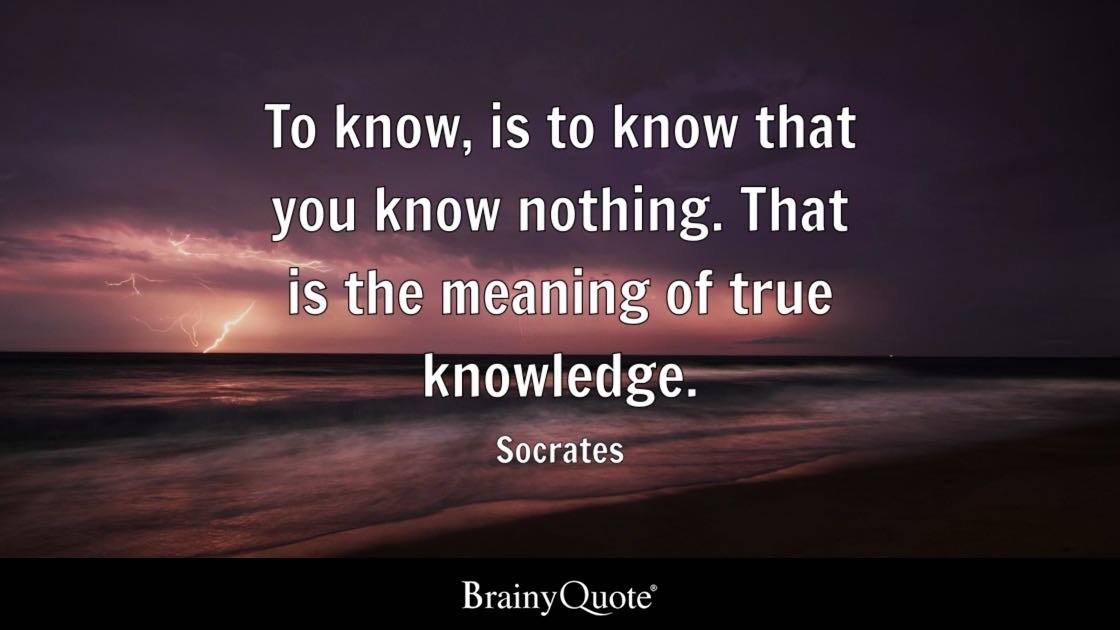
“The only true wisdom is in knowing you know nothing,” Socrates famously stated, and in this, he captured the very essence of intellectual humility.
We often mistake expertise for an absolute truth, a universal key that unlocks all doors. Yet, this view is a mirage. The value and validity of our knowledge, whether in a field of inquiry or a specific skill, are inextricably tied to its context. To be a true expert isn’t just about what you know, but about understanding the boundaries of that knowledge.
Consider mathematics, a discipline celebrated for its precision and certainty. It’s a powerful tool for quantitative analysis, perfect for calculating the trajectory of a rocket or the probability of an event. But ask it to measure the depth of human sorrow or the vibrancy of a sunset, and it falls silent. These are realms where literature and art, with their rich, qualitative language, reign supreme. Mathematics’ strength lies within its specified domain; outside of it, its utility diminishes.
This principle extends to strategic thought as well. A chess grandmaster’s brilliance is rooted in the specific parameters of the game. They understand the nuances of a king’s endgame versus a complex middlegame. They know that a move that is a stroke of genius in one scenario could be a blunder in another. The strategic principles of chess can sometimes offer a valuable framework for political manoeuvring, but applying them blindly is a recipe for disaster.
As Sun Tzu, the great strategist, warned in The Art of War, “The general who wins the battle makes many calculations in his temple before the battle is fought. The general who loses makes but few calculations beforehand.”
But even this foundational text on strategy emphasizes the importance of situational awareness and adaptability. The context of the battlefield determines the success of a plan. Similarly, a business strategy that brought a company to market dominance might crumble when introduced to a new industry with different market dynamics and consumer behaviours.
A mosaic of understanding
Beyond recognizing the limitations of a single discipline, true wisdom lies in seeing how different fields of knowledge fit together holistically. Instead of viewing expertise as a monolith, we should see it as a mosaic. Each discipline from the hard sciences to the humanities, is a unique tile, valuable on its own, but its most profound meaning and beauty emerge only when it’s placed alongside others.
As the pathologist Arthur C. Aufderheide noted, “All knowledge is connected to all other knowledge. The fun is in making the connections.”
Understanding a historical event, for example, isn’t just a matter of dates and political figures; it also requires an appreciation for the economic conditions, cultural norms, and psychological states of the people involved. These interdisciplinary connections forge a more complete and nuanced understanding of our complex world.
Context, then, is not a limitation to overcome but a reminder of humility. It urges us to practice knowledge responsibly, to respect its boundaries, and to honour its interplay with other domains.
The hubris of the specialist
For those of us who have dedicated our lives to a specific field, the gravitational pull of intellectual arrogance is potent. We begin to mistake our expertise not merely as a valuable tool but as a final answer, a universal law. This dangerous oversight, the forgetting that our knowledge is inherently contextual, often leads to a defensive “us versus them” mentality. We dismiss differing views simply because they don’t fit our established framework.
As George Bernard Shaw cautioned, “Beware of false knowledge; it is more dangerous than ignorance.”
A false sense of certainty in our limited perspective can prove to be a greater intellectual impediment than a simple lack of information.
The dangers of incomplete knowledge
In our increasingly data-driven world, the contextual nature of knowledge takes on a new, critical dimension. We often rely on algorithms and machine learning to find patterns and make decisions, believing they offer an objective, unbiased truth.
However, these systems are only as good as the data they are fed, and that data is not neutral. It is steeped in the historical context and societal biases of its origins. An algorithm designed to approve loans, for example, may unknowingly perpetuate historical discrimination if its training data reflects past biased lending practices.
The knowledge embedded within such a system is not absolute; it is a distorted reflection of its context, capable of producing and amplifying harmful real-world consequences. This underscores the need for human oversight and a critical, contextual understanding of technology.
The evolution of expertise
Ultimately, expertise is not a fixed state but a dynamic process. In a world of accelerating change, a deep understanding of one field can quickly become obsolete without continuous learning. This is where the skill of ‘unlearning’ becomes paramount. The conscious effort to let go of outdated assumptions and make room for new, relevant information.
The true expert isn’t just the one with the most knowledge, but the one who is most adept at adapting what they know. This intellectual flexibility is the antidote to arrogance. It reminds us that our most valuable skill may not be what we learn, but how effectively we can unlearn.
True intellectual growth, however, lies in the humble recognition of our limitations. By acknowledging that the circumference of our knowledge is defined by its context, we open ourselves up to new ideas and perspectives. It tempers judgment, fosters humility, and allows for genuine intellectual exchange.
We become receptive to the possibility that what is “correct” for us might not be for someone else, whose context is entirely different.
The philosophy of coexistence is rooted in this awareness. It encourages us to expand the boundaries of our understanding beyond our own immediate circle of influence to other people, different cultures, and even other species and extending our intellectual gaze to the entire universe.
By expanding our field of inquiry to the larger universe of interconnected systems, we move from a state of ‘knowing-it-all’ to a state of understanding. The understanding that you (and your knowledge) exists within the larger cosmos.
Expertise is not a fixed destination but a continuous journey of contextual awareness, one that deepens as we humbly embrace the vast, unknown territory that lies beyond our own horizon.