
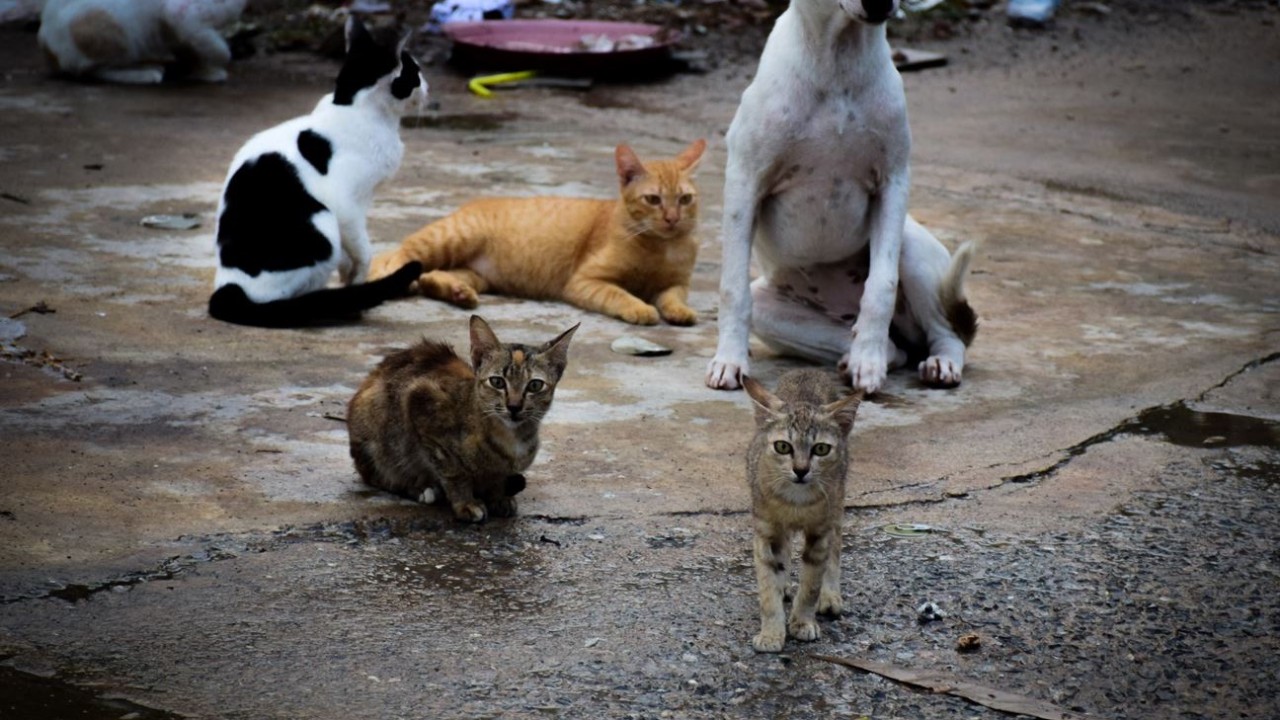
A stay cat in my neighbourhood gave birth to 7-8 kittens in her litter. Suddenly, we had meows echoing into our narrow dead-end lane. Our quiet little nook got acquired by stray cats. My neighbour’s kid felt pity and started putting milk of the cute little kittens. They were stray so he couldn’t hold them but felt content providing milk on a daily basis.
Two months later the kittens were now stronger and would run around, climb trees and ledges on the boundary wall or hide under the cars. One day by mistake, a kitten hiding under the car got run over. It was a terrible sight for the little kid. The kitten lay badly wounded, half-dead wailing in agony. The mother hearing such Loud cries came around, looked at the kitten, rolled it over with her paw, tossing it aside in the process and moved on.
The humans around like me and the little boy were shocked. Yet, others still in disbelief considered it a bad omen. They talked about donations to the temple and animal relief fund equally as if some karmic injustice needed to be set right. Fearful of the retribution it may bring.
Ironically, at the individual level, we mourn the kitten we din’t intend to hurt but at the macro level, we allow rules to cut forests or even drop bombs that kill not just the stay cat but also other humans.
The cat with all its motherly instincts moved away from its offspring. This raises 3 philosophical questions:
1. Does this mean that animals don’t feel love for their offspring?
When the mother cat rolled her wounded kitten aside and moved on, it felt harsh to us. Yet, it may not mean that animals do not love their young. Many animals show care in their own way. Mother elephants are often seen straying beside a calf that has died. Dolphins have been known to circle around their young for hours if something happens. Birds tirelessly bring food to their chicks, even when the little ones are weak and unable to fly. These are also forms of love, though not expressed the way humans expect.
The cat perhaps understood something we did not. That the kitten could not be saved. In nature, there is a quiet wisdom about conserving energy for those who can still survive. For the mother, protecting the remaining kittens was more important than mourning the one she lost. It may look like abandonment, but it could simply be instinct.
Humans, on the other hand, often extend grief with rituals. All our religions eulogise death. We mourn the departed, bury them with tradition and erect monuments in their honour. We hold on to memories because we fear forgetting.
Some scientists even suggest that life itself carries a kind of intelligence that goes beyond what we call emotion. Michael Levin, who studies bioelectric patterns in living systems, shows how even cells and tissues make decisions such as repairing, growing, or discarding in ways that look almost intentional. Maybe the question is not whether animals feel love. They do, but it is woven with instinct.
Perhaps the mother cat’s action was not the absence of love but part of this deeper biological wisdom. A quiet recognition, written into life itself, that energy must turn toward survival.
So maybe love, in the natural world, is less about holding on and more about allowing life to continue, even if it means letting go.
2. Do humans have a right to life more than other species?
In nature, balance is inherent. Every living being has its place, and it’s survival follows patterns that seem harsh to us but are part of a larger design. For instance, I remember watching the Discovery channel about a sea turtle. The mother turtle comes to the shore, finds a safe place, creates a burrow and lays about 100 eggs in one nest. These eggs need to incubate for about 50 to 60 days before being ready to hatch. Once they hatch, only 1 in 1,000 to 1 in 10,000 turtles survive to grow. Some don’t hatch correctly, some don’t reach back to the sea, and some get eaten by birds, crabs, and larger fish.
Charles Darwin theorised it as survival of the fittest. However, it misses the context that survival is not brute strength but in the quiet ability to adapt. Sometimes, it feels cruel. But nature seems to accept this as the rhythm of life.
If one does not survive, another does, and life continues. Humans too, for most of history, lived by the same law. Until just a few centuries ago, infant mortality was high, even among kings and queens. To live long enough to see adulthood was itself an achievement.
Today, science and medicine have changed this rhythm. Vaccines, hospitals, and technology have reduced the risks that once shaped human destiny. We see this as progress, but it also raises questions. If other species accept mortality as part of natural balance, do humans place themselves outside of it? Does our right to life carry more weight than that of a turtle, a bird, or even a stray cat?
Perhaps the real question is not about superiority but about humility. Maybe our species need to remember that we are part of nature, not above it.
3. What is right to life? And how much does quality of life matter?
If it were a human baby with an option to live tied to a bed for the rest of its life versus dying, what exactly would be considered humane? The question is not easy. On one side, life itself feels sacred. Every religion, every culture, has in some way protected the idea of life as a gift. Yet, we also know that living is more than breathing.
Philosophers have often wondered about this. Aristotle wrote that the “good life” was not merely existence, but a life where one could flourish, act, and find purpose. Centuries later, John Stuart Mill spoke of happiness as the measure of a worthwhile life, suggesting that quality cannot be ignored when we think about survival. Modern debates on euthanasia and assisted dying echo the same dilemma. What matters more the length of life or the dignity within it?
Medicine has stretched the boundaries of survival. Machines can keep the heart beating, tubes can feed the body, drugs can extend years. But if those years are spent without awareness, freedom or connection, is that truly life? In many hospitals, these questions play out silently in intensive care units, where families must decide whether to prolong treatment or let go.
Perhaps the mother cat, in her instinctive way, acted on a truth we complicate: that there is a difference between being alive and truly living. For humans, this remains unsettled. We continue to struggle between our reverence for life and our longing for it to mean something more than survival.
These questions about life and death take us to another, quieter obsession of ours. Our urge to optimise.
All our science and economics is geared towards improving quality of life. We continue to look for optimising solar energy. We use investments to fund these development. All geared to imagining a bright future. Correctly predicting it. And optimising our individual chance of survival.
Today, we sell comfort.
Once upon a time, human survival was dependent on securing food as it was a scarce resource. Fighting tigers as self-preservation to differentiate our species with other species.
Then we evolved, we started farming. We tamed the plants that could be used and stored. We domesticated cattle to help plow in our agriculture enterprise. We learnt that milk from cows can be consumed by humans. It nourishes us as well as the calf.
We optimized some more. We processed that milk to create butter. We processed the grain to create bread. This bread and butter was easy to spoil. The process from grain to bread and milk to butter took time and effort, far more than the store brought toast with butter we enjoy today in an instant.
Therefore we optimized the production by mass producing both bread and butter. It moved from an individual house to a business. Then we invented refrigeration. Added chemicals to prolong shelf-life to increase the chances of survival of the business not the individual.
Before long, the grain was also optimized. Genetically modified to resist virus and pests. To maximise yield at the cost of nutrient. The preservatives that are added in minute quantities is conclusively causing cancer.
And then, in a full circle, we even optimise the tiny inconveniences we created along the way. We have now created heating spoons to ease the spreading of cold refrigerated butter. To optimise for time and convenience.
At what point does the optimization for comfort stop? Is there a minimum threshold of effort that needs to be consumed and not optimized. Is effort really the enemy? Does the 30-40 minutes to make fresh breakfast really a waste of time?