
We all carry some nostalgia for our schooldays. No matter how different our high school experiences were, that gentle tug of memory feels the same. The smell of chalk, the cacophony of lunch breaks, the quiet tension before a result announcement. A few weeks ago, I got to relive that energy, but from the other side of the table. This time, I wasn’t a student. I was a judge.
The event was called “Project 2020” at GEMS Our Own Indian School; a school-wide initiative that encouraged students to think like entrepreneurs and problem-solvers. The idea was beautifully simple yet ambitious: get students to look at real-world issues like climate change, inequality, sustainability and create solutions that could be applied beyond the classroom. But this wasn’t just about big ideas; it was about translating those ideas into something tangible, something that could stand as a business. The students had to understand the problem, design a solution, and frame the business use case around it. Essentially, they were practicing startup thinking before they even finished algebra.
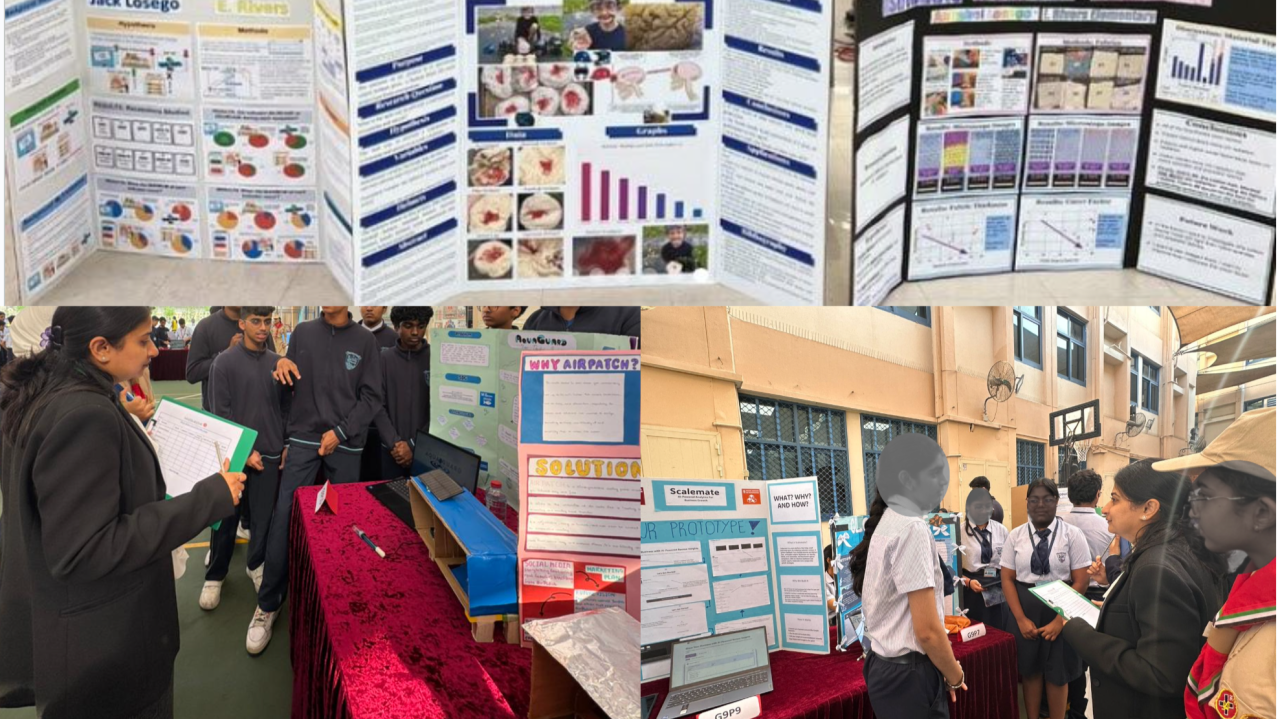
The program spanned grades 4 through 9, and every single student participated. Each class was divided into teams of six to eight members, and after initial rounds, a few groups from each class made it to the final showcase. That’s where I entered the scene, along with 8 other judges who were equally impressed.
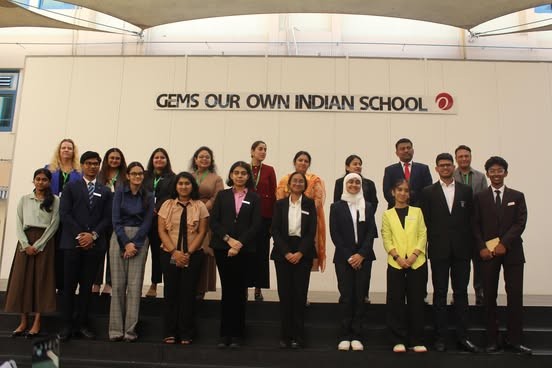
PC: Gems Our Own Indian School
And what a day it was. The Dubai sun blazed outside, but the atmosphere inside was electric. Booths lined the corridors with a colorful display of hand-drawn posters, mock-ups made from recycled material, and an endless buzz of excitement. These weren’t just kids pitching hypothetical ideas; they were founders in spirit. Each project was evaluated on a 30-point framework across six well-defined categories — Impact, Creativity, Innovation, Feasibility, Design, and Presentation. The rubric gave us structure, but the real challenge was in the nuance how do you measure vision and passion on a five-point scale?
The grade 9 teams I judged had particularly impressive ideas. Some focused on water purification through smart PH sensors; others tackled food waste composting systems. One group had designed a cooling tile prototype for Tin sheds that could help urban and rural houses; another proposed a mist dispenser to combat over-heating in cars. The creativity was astonishing, but what struck me most was their confidence. These weren’t just rehearsed speeches, they were conversations, complete with slides, statistics, and a spark in their eyes that said, we believe this can work.
And then there were student organisers who orchestrated the program. I was accompanied by a 6th grader scout who managed the logistics like a pro, making sure we had water, stationery, and directions to visit each booth. Meanwhile, the young student representative judge added an entirely different layer of reflection to the experience. Watching her evaluate her juniors, ask probing questions, and form opinions reminded me how rarely young people are given the chance to decide. Most of their lives, they are told what is right or wrong, what is good or bad. But decision-making, true judgment, exists in the grey.
As I noticed her glance over at my score sheet now and then, trying to gauge what I was thinking, I realized the subtle reversal at play: the pressure to be “good” wasn’t just on the students. It was on me. To model fairness. To show that judgment, when done right, is a responsibility, not authority.
That day, amid the laughter, the prototypes, and the sunlit chaos of the fair, I was reminded of something deeply human — our ability to learn from our environment.
Just imagine what it would be like growing up knowing how to run a business at fourteen, even if, it is make-believe. These students, who already understand global issues like climate change, inequality, or sustainability, have a much higher chance of carrying that awareness forward. In five to seven years, when they step into the corporate world or launch their own ventures, they will be far better equipped to effect meaningful change; not just through products and profits, but through perspective.
As humans, we possess a rare and powerful trait: the ability to manifest in reality whatever we can imagine. And we can imagine anything. A hundred years ago, the idea of holding a device that could connect voices across continents was science fiction. Yet, someone, somewhere, imagined it. And today, we practically live our lives inside our smartphones.
That is why education remains humanity’s greatest tool. It doesn’t just transfer knowledge; it shapes the very way we think. It can teach skills, yes, but also beliefs, ideologies, and even judgment itself. A lioness teaches her cub to hunt. A sparrow teaches its chick to fly. But humans? We teach our young how to think and, perhaps more importantly, what to value.
Yet as a society, we find ourselves in a constant loop. Defining and redefining what ‘happiness’ should mean. What is right? What is good? What deserves pursuit? Each generation questions the last, reshaping not just knowledge but culture and, in doing so, redefining humanity’s collective imagination.
Therefore, education is the one force that binds individuals into communities. Whether it is trade passed down through generations or missionaries spreading the word of God, education has always been the channel through which awareness and perspective are shared. It is what enables civilizations to evolve to build, create, and question.
However, even this most powerful tool can be misused. Education, after all, is a medium and the message matters. Consider the grim example of extremist camps that indoctrinate children to hate and fight. The same process of learning, when weaponized, can restrict thought instead of expanding it, breeding fear instead of understanding. While that may be an extreme case, it highlights a vital truth: education in itself is neutral. Its power lies in intention. In what we choose to teach, and why. Because shaping how we think also means shaping what kind of world we create.
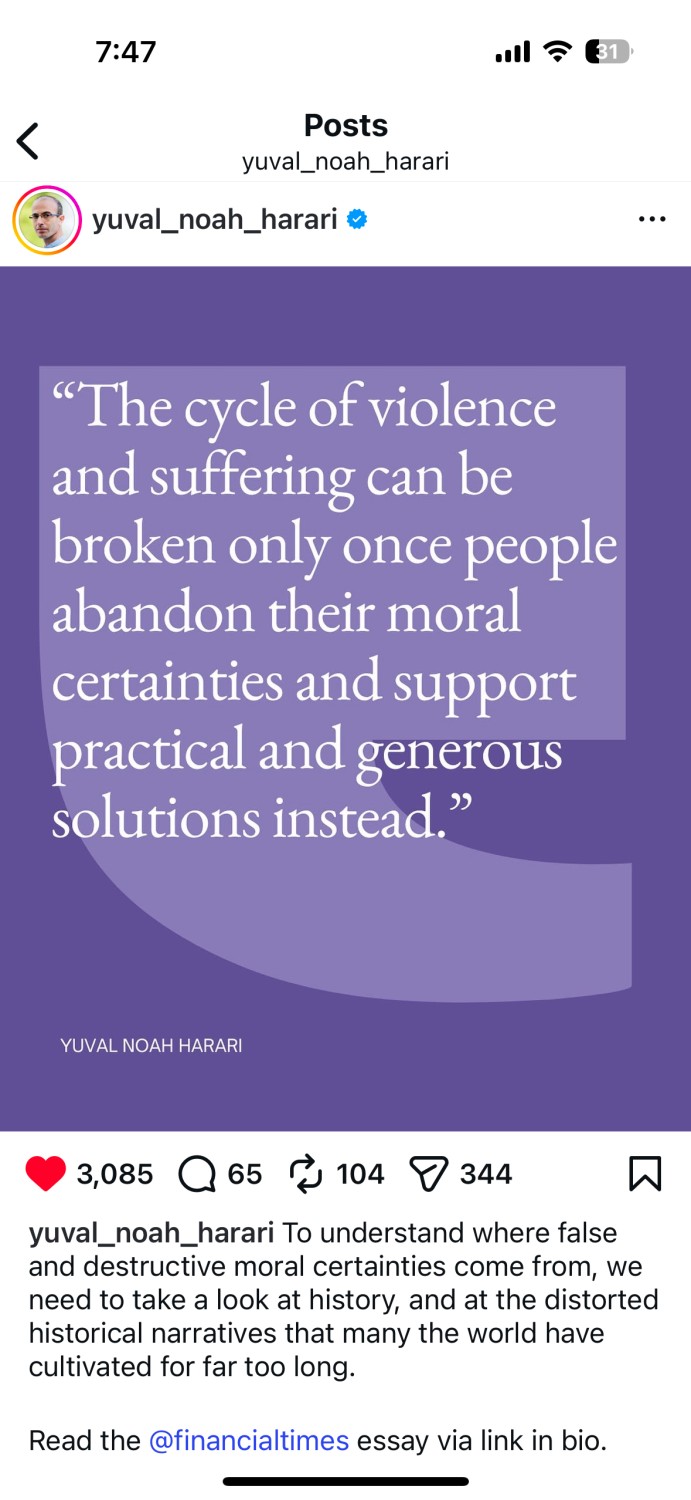
Source: Instagram
Another remarkable feature of human learning is our ability to constantly evolve. We prioritise, we adapt, and we grow. What once feels monumental in our teenage years — a grade, a heartbreak, a dream, often fades into perspective as we mature. We learn, unlearn, and relearn, constantly reshaping our understanding of what matters. This dynamic ability is what makes us uniquely human: adaptable, reflective, and capable of change.
Unlike other species that are limited by instinct or biology, we can consciously rewrite our own narratives. A tree cannot decide to grow differently, nor can a lion unlearn the hunt. But a human can. Addicts turn their lives around. People make amends. Cultures reform. Even societies evolve through re-education and awareness.
This elasticity of mind. The capacity to rewire thought. This is our greatest strength. It allows us to break patterns, challenge norms, and redefine our collective future. Evolution, for us, is not just biological; it is intellectual and emotional. Every new idea, every shift in perspective, is a small act of evolution. One that keeps humanity moving forward, one thought at a time.
At its core, education is not merely the transfer of knowledge. It is the shaping of consciousness. It is the quiet force that builds civilizations, defines ethics, and guides collective progress. The true purpose of education, therefore, extends beyond literacy or livelihood; it lies in cultivating awareness — of self, society, and the world we inhabit. It teaches us not just how to think, but why.
As humanity advances at an unprecedented pace, the need for mindful education has never been greater. We can teach intelligence, but without wisdom, intelligence becomes dangerous. We can foster ambition, but without empathy, ambition turns hollow. The challenge, then, is not only to educate minds but to enlighten them. To nurture thought that is rooted in responsibility.
Initiatives like Project 2020 are steps in that direction. It nurtures young thinkers to innovate with purpose. But we need many more such movements across the world: platforms that merge creativity with conscience, technology with ethics, progress with sustainability and awareness with knowledge.
Because the future of humanity depends not just on what we know, but on what we choose to learn and how mindfully we apply it. Education, ultimately, is the foundation of being human.