

Since the dawn of thought, humanity has been burdened by a peculiar, relentless impulse: to ask “Why?” Be it the incessant curiosity of a child’s mind when they ask, ‘why’. Or the corporate ‘5 why’ framework to determine an issue’s root cause. From the depths of the universe to scientific inquiry to biodiversity we seek why?
We don’t just exist; we relentlessly seek the script, the blueprint, the reason for this experience. This innate drive to question, to seek the origin and end of existence, is perhaps the most defining characteristic of our species. We dig into science, faith, and philosophy, always pursuing the one nagging query that sits at the centre of our self-awareness.
This leads us back to the most profound subject of all: consciousness itself. Is it merely a complex machine—a swirl of synapses and chemistry? Or, it is something more? As the final piece of the puzzle rests: What is the purpose of human consciousness?
The answer we seek often feels closer to poetry than physics, yet it is grounded in our very existence. As the philosopher Pierre Teilhard de Chardin suggested, “We are not human beings having a spiritual experience. We are spiritual beings having a human experience.”
Let us delve further into how the consciousness emerged, and how it works and reflects.
Our physical form is the starting point. The idea that the human body is a reflection of the earth is less a metaphysical claim and more a verifiable scientific truth.
The established scientific link is undeniable: virtually every element found on Earth is present, in some quantity, within us. We are literally built from the dust of our planet, functioning as a complete microcosm of its composition.
Our Astrophysical Composition Roughly 99% of the mass of the human body is made up of just six elements (oxygen, carbon, hydrogen, nitrogen, calcium, and phosphorus), elements that were initially fused in the hearts of stars that died billions of years ago.
This planetary connection suggests a beautiful evolutionary mechanism: the Theory of Elemental Equilibrium. In this view, evolution is not entirely random but a systematic process where matter seeks the next level of complexity and stability. When the fundamental elemental state reached equilibrium, those elements fused to create compounds. When the variety of natural compounds reached their own equilibrium, organisms began to emerge. This continuous striving for stable complexity is what drove the progression from insects to reptiles, to mammals, and eventually, to human beings. Now positioning us as Earth’s most complex and current form of self-expression.
This theory only partially explains our origin and brings to light the phenomenal connect between the human body and our the environment.
If our physical structure is derived from the fixed elements of the Earth, why is our behaviour, belief, and character so fluid?
We see this fluidity in how easily beliefs shift from one generation to the next, how fundamental behaviors change drastically across different cultures, and how an individual’s core character is constantly being reshaped by crisis, environment, and intentional choice throughout their lifetime.
As individuals, we are astonishingly shapeable according to our environment. Babies, for example, do not just learn words; they pick up subtle social cues, unconscious behaviors, and complex cultural beliefs simply by existing within a certain context. For example, a child growing up in India learns ‘namaste’ as salutation, while a child in other parts wouldn’t. However, this context changes when the same child is influenced by peer pressure and learns ‘Apate apate song’ as slang.
Crucially, this evolution doesn’t stop. From childhood on, our foundational values and worldview are constantly being renegotiated based on every new cultural input, media narrative, or technological shift. This continuous adaptation highlights the mind’s dynamic nature.
This constant evolution of what we consider ‘good’, ‘acceptable’, ‘fair’ and ‘deserving’ has a huge impact on how we perceive the reality around us. It highlights that the mind is not merely processing fixed data. It suggests that our cultural fields are not merely data inputs, but energetic or informational inputs that actively shape the consciousness system. Our consciousness functions as both a receiver and a transmitter, constantly attuning itself to the pervasive field of culture, belief, and information that surrounds us.
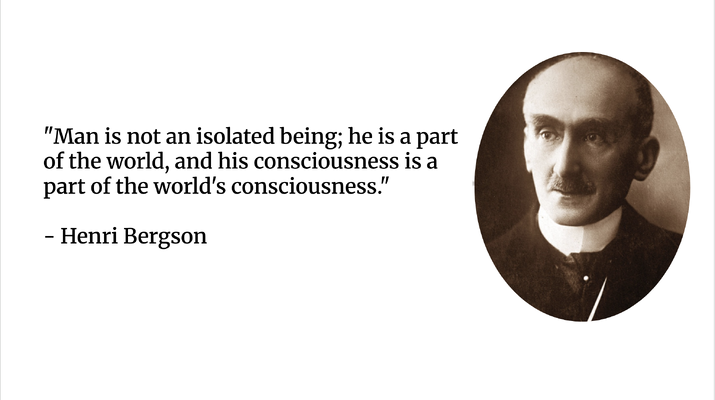
Henri Bergson won the Nobel prize in Literature in 1927
We now arrive at the core realization: if the Earth is the source of our Matter (body), what is the ultimate source of our Mind (our consciousness)?
The logical completion of this parallel points to the larger context—a Universal Energy. This energy is the “ocean” from which humanity exists and survives. Our consciousness is a minuscule reflection of this greater energy.
One that binds us beyond survival and strength. One that gently touches our spirits and brings hope despite the thousands of years in war, fighting, profiteering and fear-mongering. The little voice that brings regret to greatness of Alfred Nobel and Robert Oppenheimer alike.
Our consciousness is what holds us accountable. When we, as human beings, sought to think about choice and consequence. About oneself, our family, our community and the entire humanity. This is where consciousness acts as a bridge, connecting our individual consciousness (or soul) to that of ‘the greater context’.
We are the only species that are ‘self-aware’ in the context of the vastness of the universe. We can observe this duality. Philosophise it. Discuss it. And yet forget it, every now and then.
This leads us to the answer to our initial question: The Purpose of human consciousness is to experience and observe this duality—to exist as an individual reflection of the universal energy while simultaneously being an inseparable part of the universal energy.
When you are able to experience this joy through mindfulness, art, yoga, dance or any other ‘flow state’ of creation, it brings us joy. This experience is its own form of intrinsic joy—a profound state of contentment derived from fully being present in one’s dual existence.
This ability to choose one’s attitude and find meaning, even amidst the most crushing adversity, stands as a testament to the sovereign power of the inner, conscious reflection.
Finally, we come to the Proof of Feeling. The inherent human intuition of interconnectedness, empathy, and spiritual seeking is the felt evidence of this universal bond. Furthermore, this dual state is so powerful that we are compelled to share and validate it with other individuals which is why connection to other humans is so imperative. We seek to know and experience our reflection together.
Our consciousness is not an accidental byproduct of biology; it is the universe’s most sophisticated sensor—the final piece of the puzzle. It exists to reconcile the fixed, elemental past with the fluid, informational present.
“The secret is here in the present. If you pay attention to the present, you can improve upon it. And if you improve on the present, what comes later will also be better.” – Paulo Coelho, The Alchemist
By understanding that we are the medium through which the universal energy observes and defines itself, the question of our purpose is resolved. We are here to experience the journey, to observe the fluidity, and, through connection, to share the intrinsic joy of being the universe in miniature. The ‘why’ of our existence is, quite simply, the universe’s ongoing conversation with itself.